
Google can list gambling pages under an Indonesian government domain even when its homepage looks normal. Attackers may control a neglected subdomain or a few injected URLs to capture search traffic for judi online. Administrators can check server logs, publishing accounts and database activity to learn whether public records were reached.
The most important distinction is between an actual compromise of a government server, an abandoned subdomain taken over through DNS misconfiguration, and a fake page that merely impersonates a government identity. All three can appear similar in search results, but require different investigations and remedies.
Why official Indonesian domains are valuable to gambling SEO operators
Citizens already use .go.id portals for public services and regional notices. University .ac.id sites and village .desa.id websites also have established audiences. Existing links and indexed pages make these properties appealing to search spammers. But a .go.id suffix is not a Google ranking bonus.
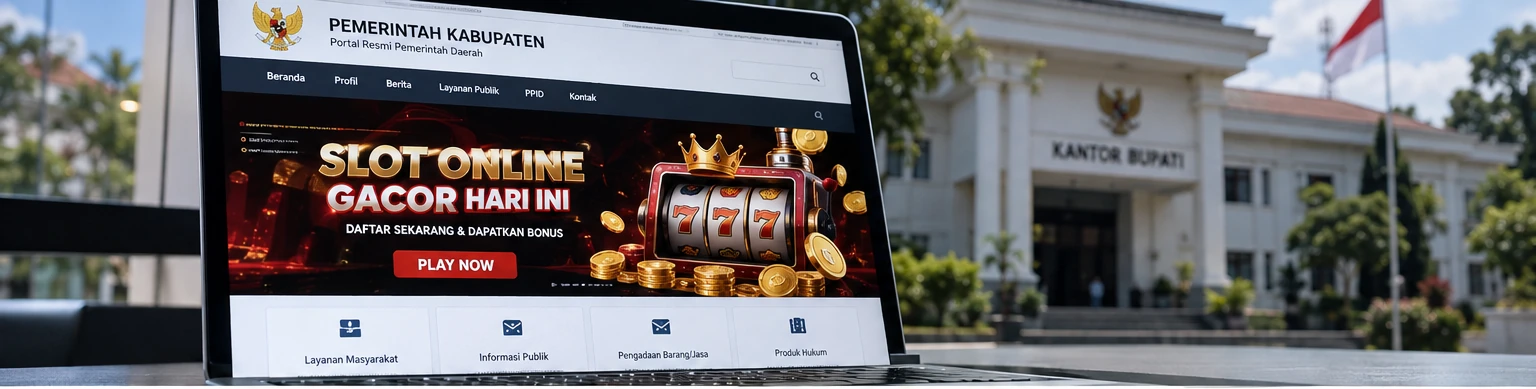
Gambling promoters pursue Indonesian-language searches such as judi online, slot gacor, togel, maxwin, casino and poker. These expressions are valuable as indicators during an investigation; their appearance in a legitimate news report or public warning is not proof of infection. Criminal operators benefit when a compromised page ranks for such queries or acts as a redirect, while the legitimate agency absorbs the reputational harm.
A compromised government page gives a gambling promoter access to a trusted domain and its search history. Tirto’s May 2026 reporting traced technical intermediaries and cross-border networks, but did not name the operator behind every suspicious URL.
How a government website becomes a gambling search result
The sequence usually starts with control over a page, hosting account or unused subdomain. The attacker publishes gambling keywords or a redirect. Google may index the URL; visitors may then be sent to a casino site. Administrators can test the current URL and inspect redirects; a search snippet may point to a page that has already been removed.
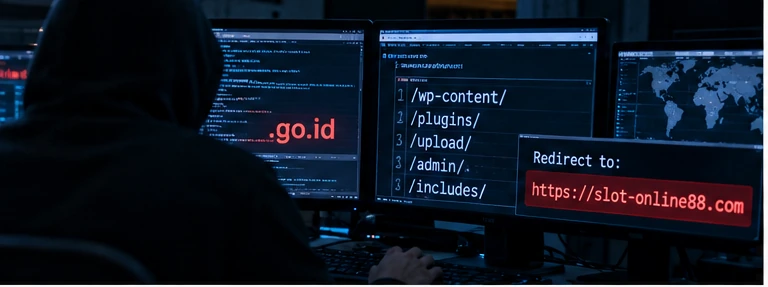
Entry points: neglected CMS installations, access and DNS
Old WordPress or Joomla deployments, unpatched plugins, exposed file-upload functions, weak credentials and poorly secured administrative accounts can create opportunities for unauthorised changes. SQL injection and cross-site scripting (XSS) are relevant vulnerability classes, but neither should be asserted as the cause of a specific incident without forensic confirmation. Attackers may also abuse a compromised vendor account or a leftover hosting service. With a dangling DNS record, an agency subdomain still points to a third-party service that is no longer claimed; an attacker may be able to claim that service and publish content under the agency’s subdomain without breaking into its main website.
Payloads: hidden URLs, SEO spam, cloaking and redirects
Some intrusions produce obvious web defacement, replacing the visible homepage. Others use stealthy defacement or URL injection: gambling landing pages are placed deep in an otherwise normal website. Attackers may insert keyword-heavy headings, deceptive metadata, links or JavaScript redirects. In SEO cloaking, a search crawler and an ordinary visitor may receive different content; AMP-related impersonation and mobile-specific behaviour can further complicate verification. A backdoor or malicious scheduled task may regenerate deleted pages unless the underlying access is removed.
Search manipulation can also occur without a successful server intrusion. A fake domain, copied branding or misleading indexed snippet may make a gambling destination appear affiliated with an agency. Investigators should verify the actual hostname, response content, redirects and ownership before describing the event as a hacked .go.id website.
What Indonesian investigations actually found
A 2025 research paper, Just Dork and Crawl: Measuring Illegal Online Gambling Defacement in Indonesian Websites, reported 453 defaced webpages observed during one month. Its combination of search-query discovery and crawling was important because search-only detection had an approximately 20.3% false-positive rate. The researchers also documented repeated defacements, repaired pages, keyword changes and redirection or hidden-URL patterns, with an average observed response time of 75.3 hours. Those figures describe the study’s sample and measurement period, not the current number of hacked government websites.

In May 2026, Indonesian outlet Tirto reported identifying 191 government and university domains connected with gambling promotion in its investigation: 97 .go.id and 94 .ac.id. The investigation acknowledged different conditions, including sites that had recovered and cases involving impersonation. Consequently, 191 should not be interpreted as 191 simultaneously active, fully compromised government servers.
Indonesia’s Ministry of Communication and Digital Affairs (Komdigi/Kemkomdigi) reported 86,826 detected gambling-content URL findings from January 2022 through May 2026, with 75,136 URLs taken down and 767 URLs still active as of 19 May 2026. These URL-level administrative findings were collected over several years; that unit differs from a count of unique compromised domains. In August 2025, a separate government notice warned that .desa.id village websites were also being targeted, expanding the problem beyond ministries and major institutions.
These totals measure different things: webpages, domains and reported URLs. They cannot be added together.
Why the problem persists after a page is removed
A contractor may finish a government portal without leaving a clear owner for patches, DNS records or monitoring. Old microsites stay online. Deleting a gambling page will not help if the attacker still controls a password, web shell, plugin or hosting account. Google may also retain the old snippet until it recrawls the URL.
Government agencies face a practical constraint: blocking an entire official domain can interrupt legitimate public services. That creates a strong reason to remove malicious URLs, contain the compromised application and coordinate with the responsible agency instead of treating every incident as a simple domain-level block. The existence of an infected URL should trigger investigation, not an assumption that all visitors have been exposed to malware or that citizen records were stolen.
How to tell whether a government result has been hijacked
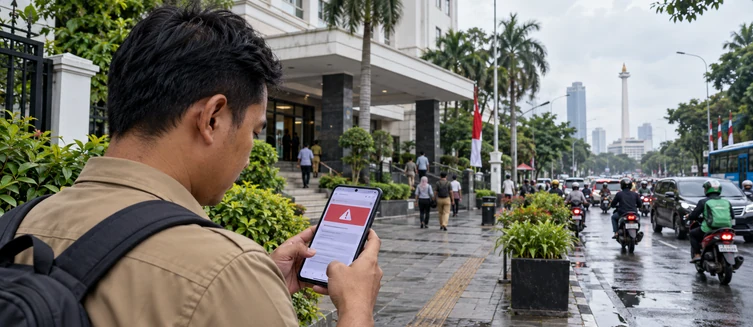
For citizens, a search result is suspicious when an official-looking link advertises gambling bonuses, deposits or winnings unrelated to the agency’s public mandate. Check the full domain carefully; an official-looking page title is not proof of ownership. Do not submit identity details, passwords or payment information to an unexpected gambling page, and avoid downloading files from it.
For a website administrator, detection needs more than a search query. Review Google Search Console indexing and security reports, compare the suspicious URL against the server’s actual response, inspect redirect chains and review web-server access logs. Check whether mobile visitors, unauthenticated users and search-engine crawlers receive different responses. Preserve evidence before changing files, and compare current assets against a trusted deployment or backup.
| Observed symptom | What it may indicate | First verification |
|---|---|---|
Gambling snippet under a real .go.id URL | Injected content, old indexed content or misleading snippet | Fetch the exact URL and inspect indexed status |
| Unexpected redirect from an agency page | Server-side rule, compromised script or external tag | Trace HTTP redirects and examine recent changes |
| Only one subdomain shows gambling content | Isolated hosting compromise or subdomain takeover | Audit DNS records and third-party service ownership |
| Page looks normal to staff but different in search | Cloaking, cached results or conditional rendering | Compare authorised fetches across user agents and devices |
| Deleted pages repeatedly return | Persistent attacker access or automated reinfection | Review accounts, scheduled jobs, plugins and file integrity |
Google dorking using site:go.id and relevant terms can help defenders discover exposed URLs, but it produces false positives. A press release warning about judol is not malicious merely because Google indexed the phrase. Search findings should be triaged against the page’s actual function and technical evidence.
What agencies should do when gambling pages appear
- Confirm scope and preserve evidence. Record affected URLs, timestamps, screenshots, server responses and relevant logs. Determine whether the issue is a genuine compromise, DNS takeover or impersonation.
- Contain attacker access. Restrict the affected application or route while keeping unaffected public services available where possible. Rotate exposed credentials, revoke sessions and secure vendor access.
- Remove the root cause. Patch the CMS and plugins, fix unsafe uploads or application flaws, remove backdoors, audit scheduled tasks and clean up dangling DNS records. Restoring a clean homepage alone is insufficient.
- Verify recovery. Check that malicious URLs return appropriate status codes, redirects no longer lead to gambling properties and server files remain unchanged after monitoring. Inspect Google Search Console and request recrawling or removals when appropriate.
- Establish continuous ownership. Assign responsibility for updates, vulnerability assessment, incident escalation and third-party contracts. Track time to detect, time to contain, recurring infections and the number of unauthorised indexed URLs.
A web application firewall (WAF) can reduce exposure to some attack patterns but does not fix stolen credentials, vulnerable source code or abandoned cloud services. Dynamic application security testing (DAST), static application security testing (SAST), access reviews, patch management and log analysis are complementary controls. Security baselines such as ISO 27001 and NIST guidance can support governance, but their names alone are not proof that a portal is protected.
In Indonesia, remediation often requires coordination between the agency owner, its Dinas Kominfo or technical team, Komdigi, the National Cyber and Crypto Agency (BSSN), relevant Gov-CSIRT functions, domain administrators and hosting providers. PANDI is also relevant to the wider Indonesian domain ecosystem. Criminal investigation may involve Polri, while financial flows and gambling enforcement involve other competent institutions. Affected citizens should use official reporting channels rather than attempting to test or exploit the vulnerable system themselves.
Does a gambling search result mean a government agency supports gambling?
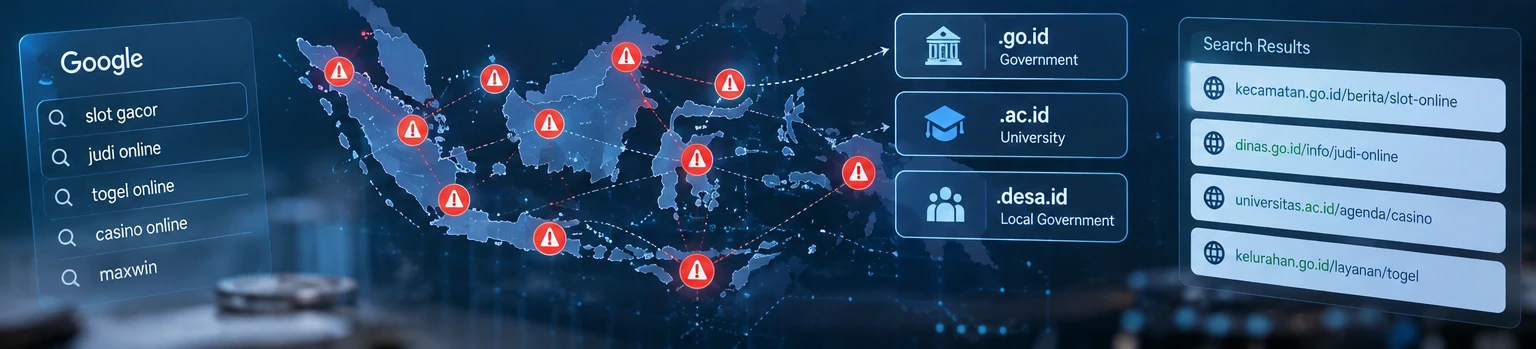
No. A forged page or hijacked subdomain says nothing about whether an agency endorses gambling. Indonesia restricts illegal online gambling, and agencies also publish warnings about slot gacor. Verify the hostname and inspect what the URL serves.
Post-remediation checks
After restoring a site, assign an owner to every domain and subdomain, patch the software, review vendor access and monitor DNS changes. Then recheck indexed URLs, redirects and publishing permissions; injected pages can remain hidden from the homepage.