

An online casino advert can reach an Indonesian phone in seconds. A rupiah deposit may use a familiar payment interface, even when the operator is based abroad. A platform can market to Indonesian users while its technical services, payment intermediaries, owners and customer support operate in different jurisdictions. That separation makes enforcement difficult.
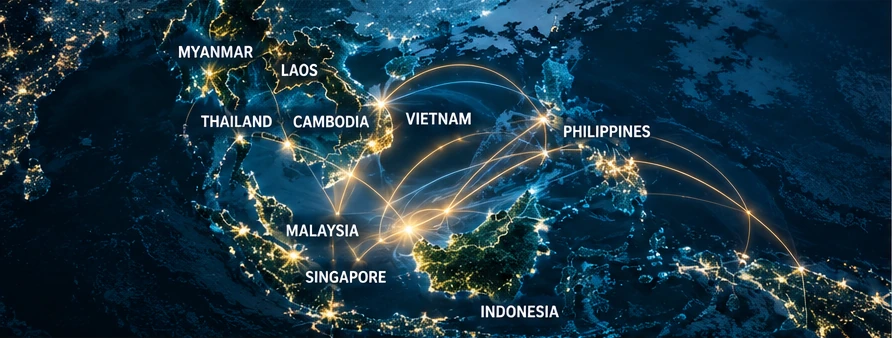
Singapore’s licensed casinos, Indonesia’s prohibited online betting, the former Philippine offshore-licensing sector and Mekong border casinos operate under different rules. Customers, payment firms, technology or staff may connect them; that does not make them one business. Any claim about a link should identify the operator, the money trail and the law that applies.
Why gambling businesses cross borders
Gambling customers, operators and payment providers often sit in different countries. An operator may seek a permissive jurisdiction for incorporation or servers while reaching customers in a country where gambling is restricted. Land-based casinos can attract visitors across national borders; online services can cross those borders without customers travelling at all. Special economic zones (SEZs), casino-linked hospitality projects and outsourced digital services can make the ownership and operating structure more complicated.
Legality depends on where a service solicits customers and which licence covers it. A Singapore casino serving foreign tourists differs from an unlicensed site accepting Indonesian deposits. A licence issued in one country does not cover every market its operator can reach.
The ASEAN gambling map: different rules, different business models
| Market | Relevant model | What distinguishes it |
|---|---|---|
| Indonesia | Prohibited online gambling; enforcement and financial monitoring | Domestic demand can be targeted by services operating outside Indonesian jurisdiction. |
| Philippines | Regulated domestic gaming; prohibited offshore POGO/IGL sector | The offshore regime is separate from licensed domestic gaming. |
| Singapore | Regulated integrated resorts and licensed gambling activities | Licensing, supervision and entry controls distinguish its legal market from unregulated offshore platforms. |
| Cambodia | Land-based casinos and border-related gambling activity | Sihanoukville and border economies have also featured in investigations of illicit online operations and scam compounds. |
| Myanmar | Border-area casino and online operations amid fragmented control | Myawaddy and Shwe Kokko illustrate how conflict and weak enforcement can complicate oversight. |
| Laos | Casino tourism and special economic zones | The Golden Triangle area highlights the risks that arise when casino activity intersects with opaque financial networks. |
| Thailand | Cross-border customers, enforcement and policy debate | Proximity to Myanmar and Cambodia makes border policing and cross-border coordination significant. |
| Malaysia, Vietnam and other ASEAN markets | Different combinations of permitted gaming, restrictions and enforcement | Rules vary by activity, operator, location and customer; a regional label cannot substitute for a country-specific legal check. |
The Greater Mekong Subregion is especially important because casino development, border trade, migration and criminal networks can overlap. Yet ASEAN is not a single gambling regulator. National laws, licensing authorities, police and financial intelligence units retain different powers and priorities.
Following a deposit through the network
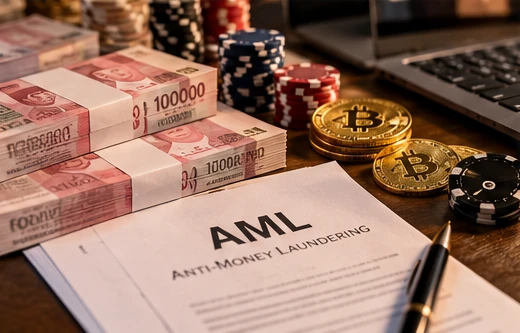
A customer deposit may pass through a bank account, payment gateway or e-wallet before reaching the company that controls the gambling service. Indonesian regulators have highlighted QRIS, bank transfers and e-wallets in gambling-related flows. Some investigations have also identified nominee accounts, shell companies and virtual assets.
The United Nations Office on Drugs and Crime (UNODC) has documented the role of casinos, junket operators, e-junkets, underground banking and cryptocurrency-related services in parts of East and Southeast Asia’s illicit financial ecosystem. A traditional junket brings customers to casinos and may arrange credit; an e-junket adapts parts of that relationship to online services. Opaque ownership and informal settlement make financial oversight harder; junket services themselves are not evidence of crime.
In documented money-laundering typologies, gambling accounts may be used to introduce funds, obscure their source through transfers or betting activity, and then withdraw money that appears to have a different origin. These typologies identify suspicious patterns, not the conduct of every customer. Financial Action Task Force (FATF) standards on anti-money laundering and counter-terrorist financing (AML/CFT), beneficial ownership and customer due diligence are relevant to distinguishing supervised operations from high-risk channels.
Indonesia: the customer-facing end of a regional network
Indonesia prohibits online gambling, yet overseas services still target its residents. PPATK’s turnover and deposit estimates cover activity detected in Indonesia; they do not map the operator or the final destination of proceeds. For yearly totals and payment-channel detail, see the banking and payments analysis.

Komdigi removes online material, PPATK traces suspicious flows, and police investigate organizers and laundering networks. To assess whether demand has fallen, compare payment activity and access to replacement sites over time.
The Philippines: what happens when an offshore model is banned?
The end of an offshore licence leaves a practical question: did the operator close, restructure or move? Answering it requires the company names, dates and operating roles. For the statutory history and the distinction between offshore and domestic Philippine gaming, see our policy comparison.
Border casinos, special economic zones and the scam-compound problem
Cambodia’s Sihanoukville, Myanmar’s Myawaddy–Shwe Kokko area and parts of Laos have appeared in reporting on casino-linked crime, online fraud and trafficking. The documented links concern particular places and operators, not every casino: some criminal groups exploited properties, logistics, payment relationships or personnel associated with gambling ventures. During the COVID-19 period, some operations shifted toward online fraud as tourism and casino activity were disrupted.
UNODC and international reporting describe scam compounds in which people have been trafficked or coerced into online fraud, including cryptocurrency investment and romance scams sometimes called pig-butchering. These are not merely another type of gambling business. Forced criminality, confinement and trafficking represent distinct harms requiring victim protection as well as prosecution of organizers. Armed actors, including the Karen National Army (KNA) in reporting concerning the Myanmar border, add further complexity to territorial control and enforcement.
Reports about casino tourism, illegal betting and forced cyberfraud describe different activities. Investigators need records tied to a specific operator before connecting them.
Revenue, work and community costs
Licensed casino tourism can generate employment, hospitality spending and public revenue where national law permits it. The distribution of those benefits depends on licensing, tax design, local procurement, labor protections and oversight. Offshore online operations may generate fees and service-sector jobs in a host jurisdiction while exposing customers elsewhere to risks that the host government does not fully internalize.
Indonesia’s enforcement costs include payment-account misuse and financial investigations, while households may lose savings or divert money from ordinary spending. Turnover cannot quantify those harms; estimates need separate evidence on household losses, debt, crime and demand for treatment.
A worker recruited into a scam compound may be forced to commit offences. Investigators need to distinguish that person from an organizer, knowing facilitator or customer, and responses must include victim protection.
How to judge whether a cross-border gambling claim is credible
Five checks help separate credible claims from misleading ones:
- Which jurisdiction is involved? Identify separately where the customer, operating company, server, payment intermediary and ultimate owner are located.
- What activity is being described? A licensed resort, online betting platform, payment service, junket and cyberfraud compound are not the same business.
- What does the number measure? Turnover, deposits, gross gaming revenue, seized assets, alleged proceeds and tax collections cannot be used interchangeably.
- Is the claim current? Philippine offshore licensing rules changed decisively in 2024–2025; a previously issued license should not be described as current authorization.
- What evidence links the actors? Prefer statutes, regulator notices, financial-intelligence findings and court records over assumptions based on a shared address or nationality.
An advertisement may claim that a foreign license makes a casino legal for Indonesian users. Foreign authorization does not override Indonesian law, and an attractive interface says little about ownership, payment security or the ability to recover funds.
What cross-border enforcement requires
A cross-border case depends on records that can be shared: company ownership, payment recipients, platform logs and evidence about who controlled the service. ASEAN or bilateral channels can help authorities obtain them; national agencies still apply local law and need to protect people coerced into online fraud.
Networks may change domains or intermediaries while an investigation is under way. Follow-up reports should name which accounts, sites or people remained active, and keep those results separate from content removals or asset seizures.