
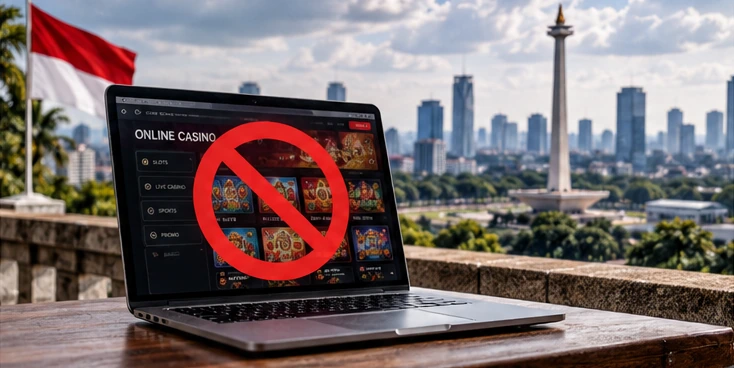
Indonesia blocks online gambling sites through several enforcement routes. The Ministry of Communication and Digital Affairs (Komdigi) identifies suspected gambling content and coordinates access restrictions with internet service providers (ISPs) or removal requests with online platforms. Banks, financial regulators and police address payments and operators separately. An ISP block can make a domain inaccessible in Indonesia without taking its server offline elsewhere.
Who is responsible for blocking gambling sites in Indonesia?
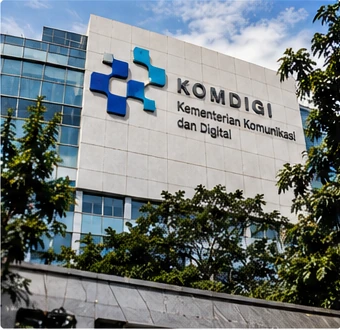
Komdigi, formerly the Ministry of Communication and Informatics (Kominfo), leads administrative enforcement against prohibited digital content. Its digital-space supervision functions assess reports, coordinate website access restrictions and engage with platforms. The ministry works with Indonesian ISPs and digital service providers, which may need to implement access restrictions or remove content under applicable rules.
Other institutions perform distinct functions. The Financial Services Authority (OJK) instructs supervised banks to investigate or restrict accounts associated with suspected online gambling. The Financial Transaction Reports and Analysis Center (PPATK) analyzes suspicious financial flows. Bank Indonesia oversees payment systems within its mandate. The Indonesian National Police (Polri), including cybercrime investigators, pursue criminal investigations rather than simply maintaining website blocklists. The National Cyber and Crypto Agency (BSSN) has a broader cybersecurity role, especially where government systems are compromised; it is not interchangeable with Komdigi's content-blocking function.
How a gambling website is detected and blocked
- Detection. Cyber patrols, automated monitoring, keyword searches, public complaints and reports from other agencies identify suspected gambling websites, promotional posts, URLs or compromised domains. Government descriptions of its monitoring infrastructure refer to an AIS monitoring engine using keyword-based searches and artificial intelligence.
- Verification. Reviewers examine the reported address and content and retain relevant digital evidence. A gambling-related keyword alone does not establish that an entire domain is unlawful: context and the actual content matter.
- Classification and routing. A standalone gambling domain may be referred for access restriction. A gambling advertisement on YouTube, Facebook, Instagram, TikTok, Telegram or X instead may require a platform takedown request. A compromised legitimate site may require both content remediation by its administrator and an access-control decision.
- Distribution of restrictions. Verified domain entries may be placed in the government's Trust Positif (TRUST+Positif) restriction infrastructure and communicated to network operators. Komdigi's published technical account describes Response Policy Zone (RPZ) and TKPPSE systems used to distribute or implement access restrictions across participating networks.
- Follow-up. Authorities can revisit reported domains, examine replacement sites and coordinate with platforms, hosts and investigators when the same gambling operation reappears through another address.
What actually happens when an ISP blocks a website?
An ISP can restrict a domain through its DNS resolver. Response Policy Zones (RPZ) are one way to apply DNS rules, although configurations vary by provider. An error or redirect rarely names the rule that caused it; check service notices or ask the ISP for an explanation.
An IP block restricts traffic to a network address and may affect unrelated sites hosted there. URL filtering can target a path, but the provider needs visibility into the request. With HTTPS, the full path is ordinarily encrypted, so the phrase “blocked URL” does not reveal whether Komdigi or an ISP used DNS, IP or path-level controls.
A platform can remove a gambling post, advertisement, account or hosted file after reviewing a request. Depending on its decision, that content may disappear outside Indonesia as well. A hosting provider can remove source material; an ISP block instead limits access on a network.
| Action | Typical target | What the action leaves unresolved |
|---|---|---|
| DNS restriction | Domain name | The hosting server was shut down |
| IP restriction | Network address | Only one website is affected |
| Platform takedown | Post, account, ad or hosted content | The operator has been arrested |
| Bank account restriction | Suspected financial account | The website itself has been blocked |
| Criminal investigation | Suspected people and networks | Every associated domain is already inaccessible |
What laws allow Indonesia to act against online gambling?

Indonesia's prohibition of online gambling content is supported by the Electronic Information and Transactions Law (ITE Law), as amended by Law No. 1 of 2024. The law addresses the intentional distribution or making accessible of electronic information or documents containing gambling content. Relevant enforcement may also involve provisions of the Criminal Code (KUHP) and the rules governing private electronic system operators (PSE), including Ministerial Regulation No. 5 of 2020 and its amendments.
A content restriction is an administrative action. A criminal case requires separate evidence about a person’s conduct.
Why blocking websites is only one part of enforcement
Operators can switch domains, move hosts or send users through social accounts and compromised sites. Komdigi also pursues promotions, while financial authorities review suspected payment channels.
In an October 2026 statement, Komdigi said it handled 2,087,109 gambling-related content items in 2025. Of these, 1,809,358 were associated with websites and IP addresses; the rest appeared across file-sharing services and platforms including Meta, Google and YouTube, X, Telegram and TikTok. These are content actions, not a roster of operators or a count of sites permanently disabled.
Komdigi’s November 2025 review found Cloudflare services on more than 76% of a 10,000-site sample of gambling sites it had handled. That sample says nothing about the share across all Indonesian gambling sites. Shared content-delivery networks can also host legitimate services, so a network-level restriction may affect unrelated websites.
How financial enforcement targets gambling payments

Komdigi can refer suspected gambling-linked accounts to the Financial Services Authority (OJK). OJK can direct supervised banks to conduct Enhanced Due Diligence (EDD), examine related accounts and apply restrictions where warranted. Banks also use Know Your Customer (KYC) and anti-money laundering (AML) controls. The Financial Transaction Reports and Analysis Center (PPATK) analyzes suspicious flows under Indonesia’s anti-money-laundering framework, including Law No. 8 of 2010.
EDD requires a bank to review an account; it is separate from a decision to freeze it or a finding of an offence. Dated figures for referrals, reviews and blocks appear in the crackdown timeline.
What happens when gambling content appears on a legitimate website?
Attackers can deface or compromise a legitimate site and insert gambling advertisements or outbound links. In May 2025, Komdigi reported restricting access to the former PeduliLindungi.id website after a public complaint and verification of gambling-related content added through defacement. Authorities responded to the inserted content; the domain’s original purpose was public health.
A legitimate site owner should preserve logs, remove injected content, change compromised credentials, patch affected software and check for hidden pages. After cleanup, the owner can ask the ISP or Komdigi to review the restriction and provide evidence that the site is secure.
How can a user tell whether a site is blocked or simply unavailable?
A failed page load can come from a network restriction, expired domain, DNS fault, server outage or hosting suspension. Check the address and the owner’s service notices; site administrators can compare resolver responses and authorised logs before reporting a mistaken block.
If a legitimate Indonesian business or public-service site appears to have been incorrectly restricted, document the domain, exact error, time, ISP and relevant screenshots, then seek clarification through the ISP and Komdigi's official complaint or normalization channels. Avoid circulating gambling links as part of a public complaint. Website owners should provide evidence that the offending material has been removed and that the site is under their control.
Can gambling websites return after being blocked?
Yes. Operators can register a replacement domain while the original block stays in force. Komdigi and ISPs handle new addresses; financial authorities and police work on related accounts and networks. The crackdown timeline tracks those separate actions.
Frequently Asked Questions
No. Komdigi coordinates and initiates content restrictions, but ISPs, platform operators and hosting services implement different kinds of measures. Criminal and financial enforcement belong to other competent institutions.
No. Removing or limiting a search listing affects discoverability. An ISP restriction affects access through a network. A site can disappear from search results while remaining reachable, or be blocked on a network while its listing still exists.
Yes. A legitimate website may be compromised and display gambling material, while broad network restrictions can affect shared infrastructure. Owners should remediate the content and seek review of any mistaken or outdated restriction.